
Overview
A four-week intensive project that demonstrates how to integrate AI tools into a rigorous design practice without letting automation replace critical thinking. The case study follows the design of FitFuel, a mobile fitness app for busy professionals, from research hypothesis validation through feature prototyping.
The work centers on three core moves:
(1) Using Claude and AI research tools (Perplexity) to synthesize competitive and user data faster.
(2) Applying human judgment to audit bias and test assumptions.
(3) Prototyping one focused feature (plan-level re-entry for lapsed users) with documented source material linking design decisions back to validated evidence.
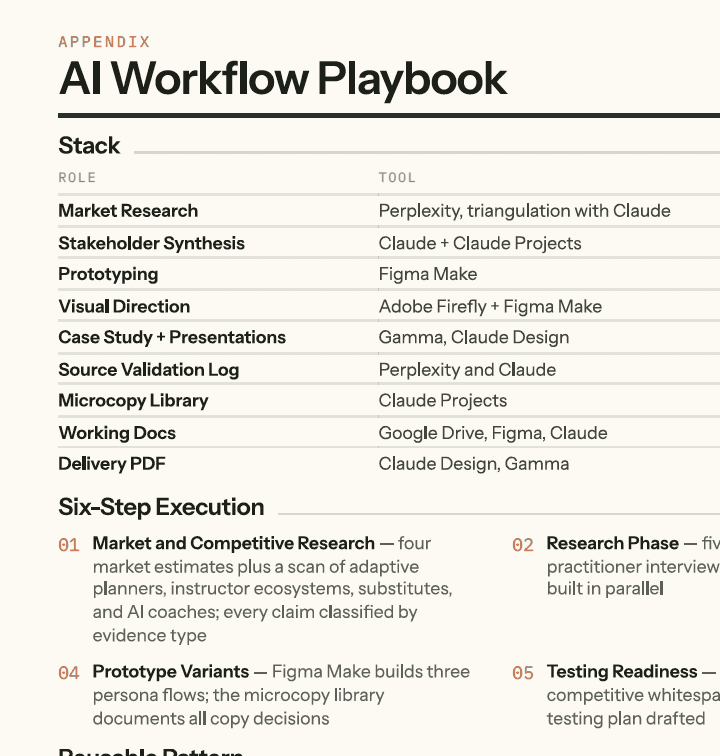
Final delivery was a stakeholder pitch deck with prototype all completed using a curated AI tech stack.
A four-week intensive project that demonstrates how to integrate AI tools into a rigorous design practice without letting automation replace critical thinking. The case study follows the design of FitFuel, a mobile fitness app for busy professionals, from research hypothesis validation through feature prototyping.
The work centers on three core moves:
(1) Using Claude and AI research tools (Perplexity) to synthesize competitive and user data faster.
(2) Applying human judgment to audit bias and test assumptions.
(3) Prototyping one focused feature (plan-level re-entry for lapsed users) with documented source material linking design decisions back to validated evidence.
Final delivery was a stakeholder pitch deck with prototype all completed using a curated AI tech stack.
Overview
A four-week intensive project that demonstrates how to integrate AI tools into a rigorous design practice without letting automation replace critical thinking. The case study follows the design of FitFuel, a mobile fitness app for busy professionals, from research hypothesis validation through feature prototyping.
The work centers on three core moves:
(1) Using Claude and AI research tools (Perplexity) to synthesize competitive and user data faster.
(2) Applying human judgment to audit bias and test assumptions.
(3) Prototyping one focused feature (plan-level re-entry for lapsed users) with documented source material linking design decisions back to validated evidence.
Final delivery was a stakeholder pitch deck with prototype all completed using a curated AI tech stack.
A four-week intensive project that demonstrates how to integrate AI tools into a rigorous design practice without letting automation replace critical thinking. The case study follows the design of FitFuel, a mobile fitness app for busy professionals, from research hypothesis validation through feature prototyping.
The work centers on three core moves:
(1) Using Claude and AI research tools (Perplexity) to synthesize competitive and user data faster.
(2) Applying human judgment to audit bias and test assumptions.
(3) Prototyping one focused feature (plan-level re-entry for lapsed users) with documented source material linking design decisions back to validated evidence.
Final delivery was a stakeholder pitch deck with prototype all completed using a curated AI tech stack.
Overview


FitFuel Direction Board
A design specification that combines visual tokens, component anatomy, accessibility requirements, and copy tone into a single source.

Stakeholder report
A research-to-test gate: evidence, prototype, and decision rules for three possible test outcomes.
AI Playbook