
LAUREN ARMENTA
SENIOR PRODUCT DESIGNER
LET'S WORK TOGETHER
DesignLab 2026
Role: Senior Product Designer
AI in UX DesignLab Certification
FitFuel - AI fueled casestudy
About
FitFuel is a mobile fitness app concept for busy professionals designed using entirely AI outputs. Claude, Perplexity, and Figma Make sped up the research, synthesis, and prototyping. I kept ownership of evidence interpretation, bias auditing, and design accountability. The work moved from research hypotheses through thematic analysis of 7 interviews (5 users, 2 practitioners) to a three-variant Figma prototype and a stakeholder pitch deck.
Challenge
Most fitness apps adapt the workout but not the plan. People who return after a long gap often have less time, a different body, or new access needs. They come back to a plan that no longer fits them. The question was how the app should respond to a returning user. I also had to use AI to move faster without letting fluent output stand in for evidence.
Goal
Design focused re-entry flow(s) that rebuild a returning user’s plan around their current reality. That flow had to work for three variants: changed workload, changed physical capacity, and fluctuating capacity. Every flow treated accessibility as part of the design rather than a separate mode. The final deliverable was a decision-ready package and pitch deck to authorize an A/B usability test.


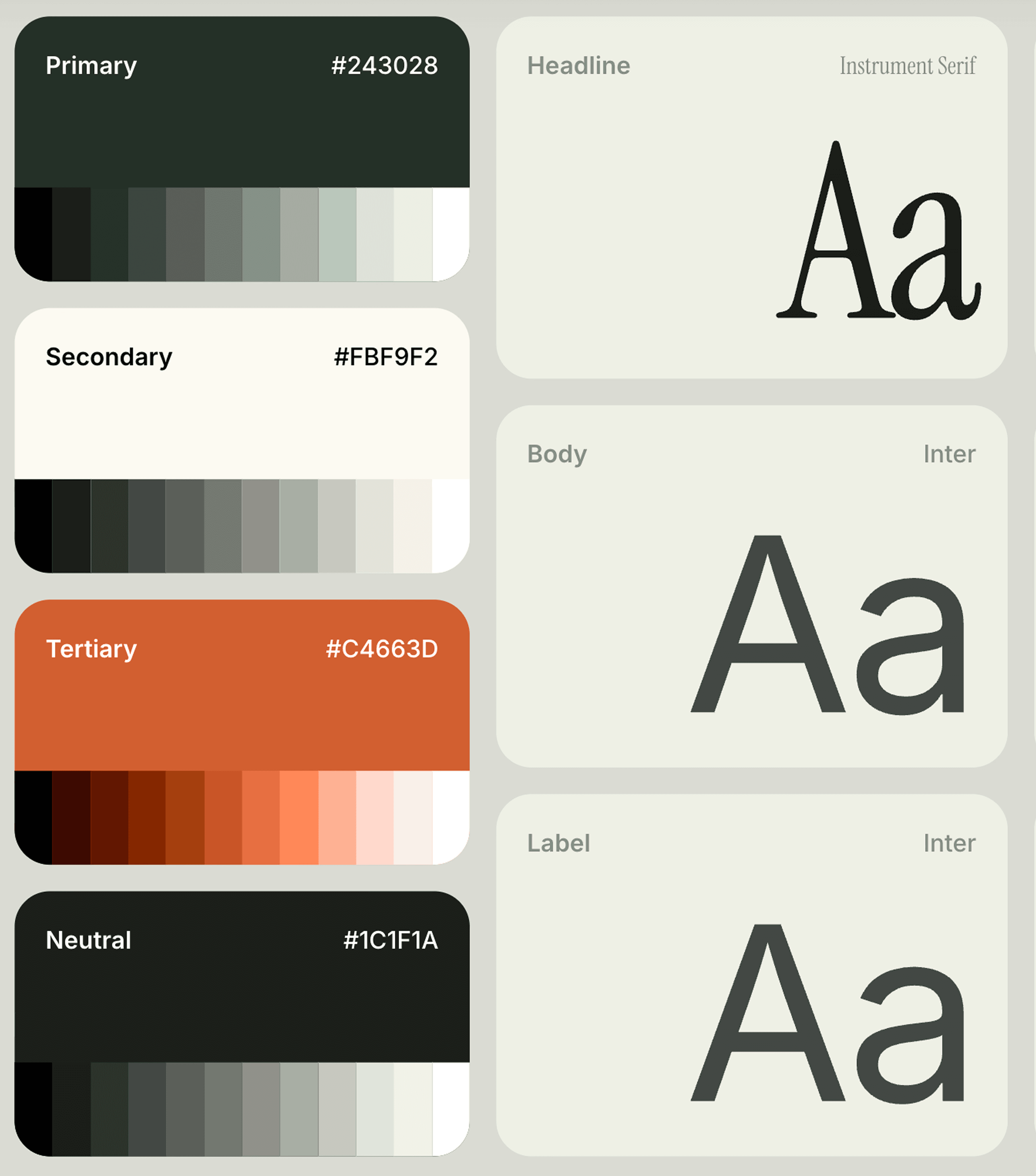
FitFuel Direction Board
A design specification that combines visual tokens, component anatomy, accessibility requirements, and copy tone into a single source.

Stakeholder report
A research-to-test gate: evidence, prototype, and decision rules for three possible test outcomes.
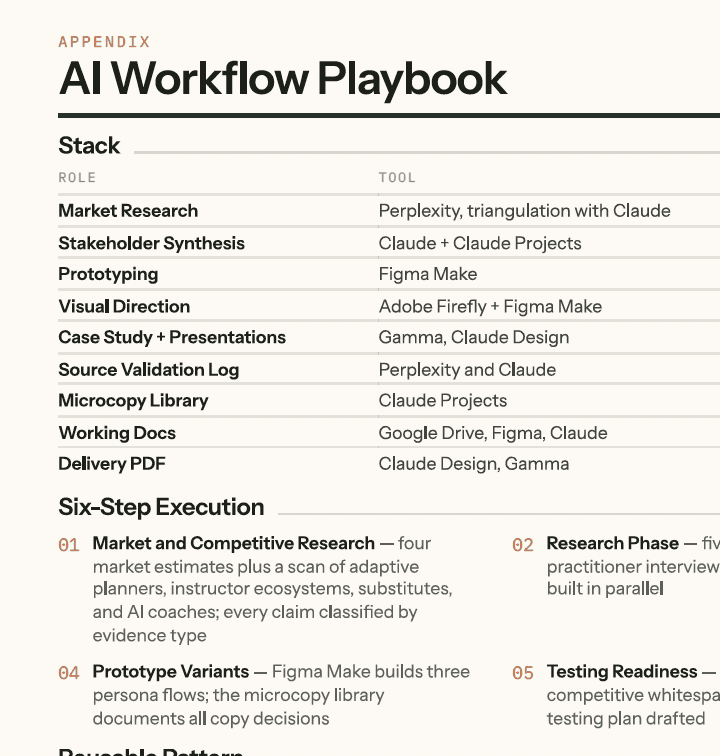
AI Playbook
A process framework that separates AI logistics from human judgment, with gatekeeping at each phase.

DesignLab 2026
Role: Senior Product Designer
AI in UX DesignLab Certification
FitFuel - AI fueled casestudy
About
FitFuel is a mobile fitness app concept for busy professionals designed using entirely AI outputs. Claude, Perplexity, and Figma Make sped up the research, synthesis, and prototyping. I kept ownership of evidence interpretation, bias auditing, and design accountability. The work moved from research hypotheses through thematic analysis of 7 interviews (5 users, 2 practitioners) to a three-variant Figma prototype and a stakeholder pitch deck.
Challenge
Most fitness apps adapt the workout but not the plan. People who return after a long gap often have less time, a different body, or new access needs. They come back to a plan that no longer fits them. The question was how the app should respond to a returning user. I also had to use AI to move faster without letting fluent output stand in for evidence.
Goal
Design focused re-entry flow(s) that rebuild a returning user’s plan around their current reality. That flow had to work for three variants: changed workload, changed physical capacity, and fluctuating capacity. Every flow treated accessibility as part of the design rather than a separate mode. The final deliverable was a decision-ready package and pitch deck to authorize an A/B usability test.
FitFuel Direction Board
A design specification that combines visual tokens, component anatomy, accessibility requirements, and copy tone into a single source.
Stakeholder report
A research-to-test gate: evidence, prototype, and decision rules for three possible test outcomes.
AI Playbook
A process framework that separates AI logistics from human judgment, with gatekeeping at each phase.
DesignLab 2026
Role: Senior Product Designer
AI in UX DesignLab Certification
FitFuel - AI fueled casestudy
Challenge
Most fitness apps adapt the workout but not the plan. People who return after a long gap often have less time, a different body, or new access needs. They come back to a plan that no longer fits them. The question was how the app should respond to a returning user. I also had to use AI to move faster without letting fluent output stand in for evidence.
Goal
Design focused re-entry flow(s) that rebuild a returning user’s plan around their current reality. That flow had to work for three variants: changed workload, changed physical capacity, and fluctuating capacity. Every flow treated accessibility as part of the design rather than a separate mode. The final deliverable was a decision-ready package and pitch deck to authorize an A/B usability test.

FitFuel Direction Board
A design specification that combines visual tokens, component anatomy, accessibility requirements, and copy tone into a single source.
Stakeholder report
A research-to-test gate: evidence, prototype, and decision rules for three possible test outcomes.
AI Playbook
A process framework that separates AI logistics from human judgment, with gatekeeping at each phase.
About
FitFuel is a mobile fitness app concept for busy professionals designed using entirely AI outputs. Claude, Perplexity, and Figma Make sped up the research, synthesis, and prototyping. I kept ownership of evidence interpretation, bias auditing, and design accountability. The work moved from research hypotheses through thematic analysis of 7 interviews (5 users, 2 practitioners) to a three-variant Figma prototype and a stakeholder pitch deck.